
Content Marketing Strategy for Lean Teams: A Practical SEO and GEO Framework
If your team is small, “just publish more content” is not a strategy. It is a way to burn out the one person who already has too much on their plate.
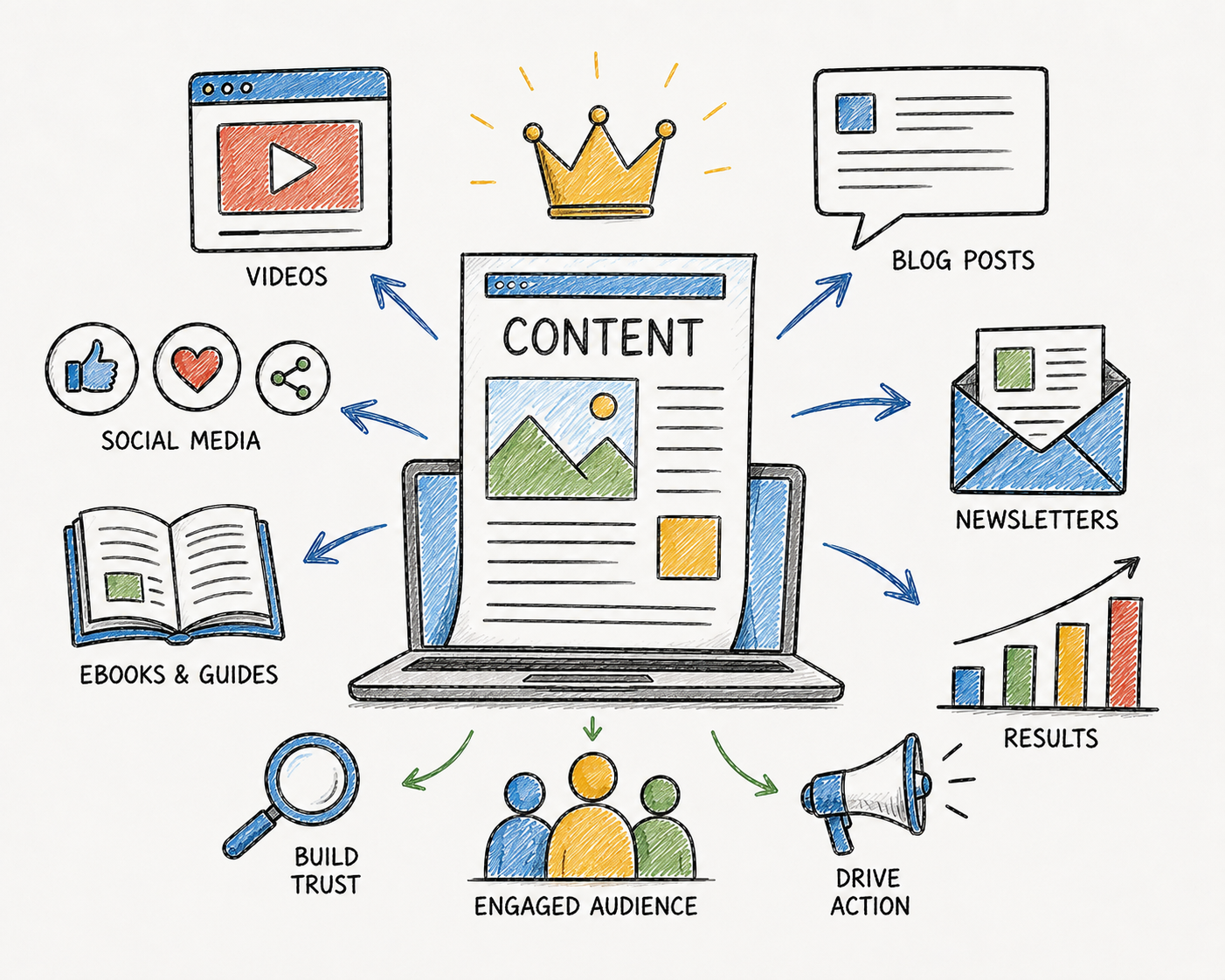
A real content marketing strategy for lean teams does the opposite. It narrows the focus so the content you do have time to create works harder in search engines, in AI answer tools, and in the conversations that lead to business.
This is the system I walk clients through when they tell me they need content but do not have the capacity to “do it all”: a small number of priorities, applied consistently, aimed at both traditional SEO and the newer discipline of generative engine optimization (GEO).
What a content marketing strategy for lean teams actually includes
A workable content strategy for a small team has four parts: a defined audience, a short list of topics that audience already searches for, a consistent format and publishing rhythm, and a way to track whether the content is producing qualified interest, not just traffic.
Most lean teams are missing one or two of these, usually the audience definition and the tracking. Without them, content becomes a guessing game. With them, even a modest publishing pace compounds over time.
Start with long-tail keywords, not broad ones
If you are a small business competing against larger companies with bigger budgets, broad keywords are the wrong place to start. Terms like “marketing strategy” or “content marketing” are crowded and expensive to rank for.
Long-tail keywords, more specific phrases of three or more words such as “content marketing strategy for small business” or “blog strategy consultant for nonprofits,” are easier to rank for, attract visitors who already know what they want, and convert at a higher rate because the intent behind the search is clearer.
A simple way to find them: write down the exact questions your prospects ask you before they hire you or buy from you. Those questions, in the words your audience actually uses, are your long-tail keyword list. They also tend to be the questions AI search tools are now answering directly, which makes them valuable for both SEO and GEO.
Build a topic cluster, not a content calendar
A content calendar tells you when to publish. A topic cluster tells you why. Instead of filling a calendar with disconnected ideas, choose two or three “pillar” topics that map to your services, then plan supporting posts that go deeper on specific angles, questions, and use cases within each one.
For example, a pillar topic like “content strategy for lean teams” could be supported by posts on long-tail keyword research, repurposing one piece of content into multiple formats, or what to track instead of vanity metrics. Each supporting post links back to the pillar, and the pillar links out to the supporting posts.
Search engines and AI tools both read that structure as a signal of depth and authority on the subject, exactly what generative engines are now prioritizing over simple keyword matching.
What GEO means for a small business
Generative engine optimization, or GEO, is the practice of structuring your content so AI tools such as Google’s AI Overviews, ChatGPT, Perplexity, and similar answer engines are more likely to cite, summarize, or recommend your business when someone asks a related question. It is sometimes called answer engine optimization (AEO) or AI search optimization.
GEO does not replace SEO. It sits alongside it. Traditional search engines still reward keywords, structure, and authority. Generative engines look for the same signals, plus something more specific: content that answers a question clearly enough to be lifted, summarized, and attributed without distortion.
That is good news for lean teams because clear, well-organized writing is something you can produce without a large budget. It just takes the right structure.
How to make your content easy for AI tools to cite
Three practices make the biggest difference, and all three are achievable for a team of one or two people.
Write in direct answers. Open each section with a clear, complete statement of the answer, then explain it. AI tools tend to pull the first clear answer they find, so burying it under three paragraphs of context works against you.
Use clear, descriptive headers. Headers that state a question or a complete idea, like the ones in this article, make it easier for both search engines and AI systems to identify what each section covers and match it to a user’s question.
Keep paragraphs short and specific. Long, winding paragraphs are harder for any reader, human or machine, to extract a clean answer from. Short paragraphs with one idea each are easier to summarize accurately, which is exactly what you want when an AI tool is deciding whether to feature your business as the source.
A simple weekly system for lean teams
You do not need a content team to run this well. A workable rhythm looks like one to two hours a week spent on research and topic selection, one focused block to draft a single piece tied to your pillar topics, and a short review pass to tighten the structure, headers, and direct answers before it goes live.
Repurpose that one piece into a LinkedIn post, an email, or a short video instead of starting from scratch each time.
Consistency beats volume. A business that publishes one well-targeted, well-structured piece every other week will typically outperform one that publishes scattered content weekly with no shared focus, in search rankings, in AI citations, and in the quality of leads it produces.
Where to go from here
If your team has the expertise but not the bandwidth to plan this kind of system, that is exactly the gap a content and SEO strategy engagement is built to close: topic pillars, SEO-informed briefs, and a publishing rhythm built around your actual capacity, not an idealized one.
Download the MESSAGE Method Scorecard to see where your content and search visibility stand today, or get a next-step recommendation to talk through a content system that fits your team’s size.

Cadi Kadlecek, Marketing Strategy & Communications Consultant — Experience across integrated marketing strategy, demand generation, content programs, CRM, campaign analytics, and stakeholder communication.
Last updated: June 8, 2026
Need a content system your team can actually sustain?
Kadlecek Consulting helps lean teams clarify topic priorities, build SEO-informed content plans, and create practical publishing rhythms that support visibility and qualified conversations.
Book your free first conversation